
When your application demands a material that’s tough, corrosion-resistant, and built for high temperature and pressure, Cr-Mo fabrication delivers. Chromium-molybdenum steel compensates for the traditional weaknesses of standard steel. It’s what Boardman recommends when your project calls for versatility, durability, and long-term performance in demanding industrial service environments.
Cr-Mo steel, also called chrome-moly steel or chromium molybdenum steel, is a low-alloy steel that uses chromium and molybdenum to improve strength, temperature resistance, and pressure performance over standard carbon steel. It’s the material of choice for ASME pressure vessels, reactors, hot separators, hydrogenators, and other high-demand industrial equipment.

Low-alloy steel is considerably stronger and harder than standard steel. If your specs call for chrome-moly steel fabrication, it’s likely because of one or more of these performance advantages:
Whether your engineered drawings call for chrome moly steel or the engineers at Boardman have recommended it, we’re ready to discuss its benefits and how they can enhance the success and longevity of your next project. Contact us to discuss.
When you’re specifying material for high-temperature, high-pressure equipment, here’s what Cr-Mo brings to your project.
| Cr-Mo Property | What It Means | Why It Matters in Fabrication |
|---|---|---|
| High tensile strength | Withstands significant mechanical stress | Pressure vessels, reactors, and load-bearing equipment |
| High-temperature resistance | Performs in elevated-temperature service | Refining, petrochemical, energy, and process equipment |
| Corrosion resistance | Chromium resists certain corrosive environments | Extends service life in demanding applications |
| Abrasion resistance | Resists wear from friction or particle exposure | Equipment exposed to harsh process conditions |
| Strength-to-weight ratio | Strength without unnecessary material weight | Balances durability and design efficiency |
| Weldability | Fabricated using controlled welding procedures | Code-compliant pressure equipment |
| Machinability | Formed and finished for custom components | Complex fabrication requirements |
If your process equipment operates at elevated temperatures or pressures, Cr-Mo is likely already on your spec sheet. Boardman fabricates Cr-Mo components and assemblies for a range of high-temperature, high-pressure industrial applications:
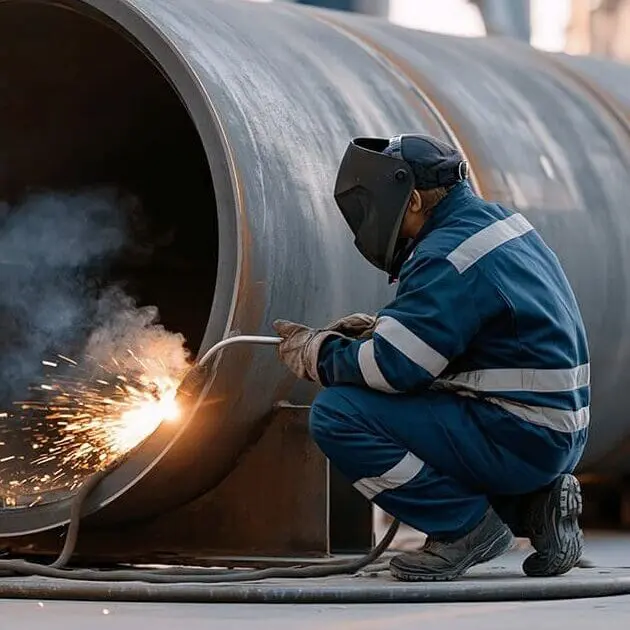
Cr-Mo fabrication isn’t the same as working with standard carbon steel. Because chromium-molybdenum steels can be sensitive to cracking, stress concentrations, and temper embrittlement, your fabricator needs proven procedures and disciplined execution at every stage.
Cr-Mo requires qualified welding procedures, controlled preheat, and interpass temperature monitoring. Boardman maintains over 1,000 qualified procedures for the full range of service requirements.
Fabrication details are designed and executed to minimize stress concentrations that contribute to cracking or premature failure. Boardman’s team controls these critical variables at every phase of the build.
Certain Cr-Mo alloys are susceptible to temper embrittlement under specific service conditions. Boardman manages this risk through material selection, heat treatment controls, and fabrication procedures.
Every Cr-Mo vessel is fabricated and inspected to ASME requirements and your project specifications. Full documentation is provided with every build: weld records, material certifications, and inspection reports.
When you’re putting ASME pressure vessels, reactors, or heavy plate assemblies into high-temperature service, your fabricator’s track record matters. Boardman has been fabricating Cr-Mo equipment for industrial customers since 1910. Here’s a snapshot of that experience:
These projects reflect Boardman’s experience where material selection, welding procedure control, stress management, and code compliance are all critical to performance.
We are experts in working low alloy, but you’ll also find these materials on our shop floor:
Chromium molybdenum fabrication supports a wide range of industrial applications. If you work in one of these sectors, there’s a good chance Boardman has fabricated equipment for a similar environment:
No matter your industry, if you have a need for low-alloy steel fabrication related to ASME pressure vessels, trayed towers and columns, or custom fabrication, contact us today.

You have options when it comes to chrome moly steel fabricators. What sets Boardman apart is the stewardship promise we keep on every project.
We guide you through the full scope, keep communication consistent, and let you set the level of involvement that works for your team. If something comes up, you hear it from us first.
If that’s the kind of fabrication partner your next project needs, let’s start a conversation.
Boardman is an Oklahoma City-based heavy fabrication company that’s been supporting industrial customers since 1910. With experience in Cr-Mo, stainless steel, carbon steel, clad, and high-alloy equipment, Boardman delivers ASME pressure vessels, trayed towers, columns, reactors, separators, and heavy plate fabrications to clients nationwide.
You choose your level of involvement. Boardman can manage the full process from engineering through delivery, or build directly from your drawings.

These are the questions engineers and procurement teams ask most often when evaluating a Cr-Mo fabricator. Don’t see yours here? Contact the Boardman team directly.
Post-weld heat treatment relieves residual stresses introduced during welding and reduces cracking risk. Specific parameters depend on material grade, wall thickness, and project requirements. Boardman manages PWHT as part of the overall fabrication scope.
Temper embrittlement is a reduction in toughness that can occur in certain Cr-Mo alloys when exposed to specific temperature ranges over time. Managing it requires careful material selection, heat treatment controls, and disciplined fabrication procedures. It’s a standard consideration on every Cr-Mo project Boardman takes on.
ASME Section VIII Division 1 and Division 2 govern the design, fabrication, inspection, and testing of pressure vessels, including those built from Cr-Mo materials. Boardman holds both certifications along with the National Board R Stamp and ASME U Stamp.
Yes. Boardman builds directly from customer-supplied drawings or manages the full engineering and design process. You choose the level of involvement that fits your project.
Boardman fabricates for customers nationwide. On-site field service covers Oklahoma, Texas, New Mexico, Colorado, Arkansas, Missouri, and Kansas.